
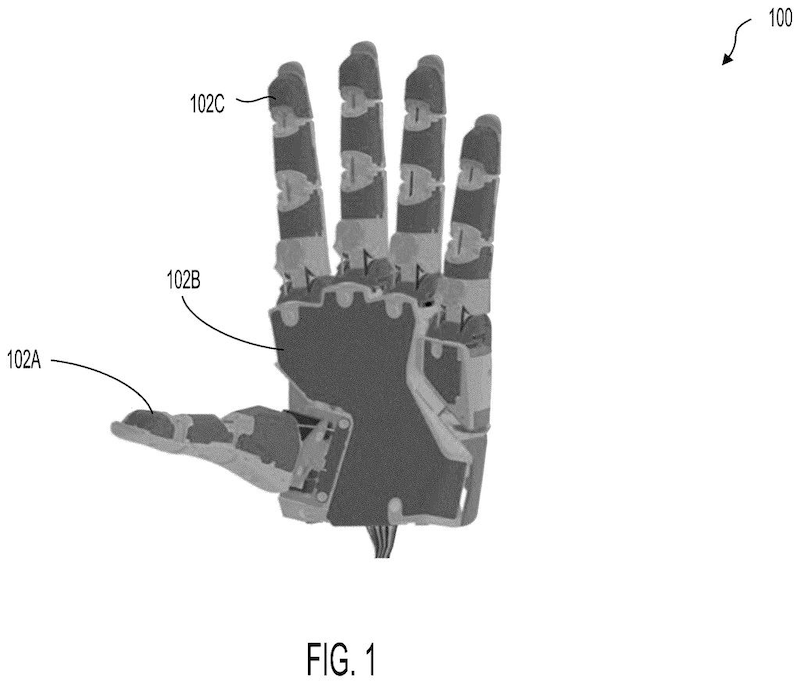
Tesla has filed a US patent application for a touch-sensitive "skin" that can be molded around robot fingers and palms, offering a potentially scalable route to contact, force and pressure detection for humanoid robots. Application US 2026/0310299 A1, published October 8, describes printing tactile sensors onto flat, flexible materials that are then heat-formed into three-dimensional shapes.
Key takeaways
- Sensor architecture: two flexible substrate layers with conductive regions, separated by a compressible layer; overlapping conductive areas form individual sensing points that respond to pressure changes.
- Sensing methods and materials: the filing covers capacitive and piezoresistive approaches and lists thermoplastic polyurethane, PET and polyimide as possible substrates.
- Manufacturability focus: screen printing, laser cutting, conductive paste deposition and thermoforming — established processes that could support volume production of tactile surfaces.
- Applications: robot fingertips, palms and end-effectors are named; the patent does not confirm use in Tesla's Optimus humanoid.
- Open questions: no sensitivity, resolution or durability figures are provided, so practical performance cannot yet be assessed.
For manufacturing automation, the filing signals continued hardware work toward dexterous manipulation — letting a robotic hand not only grasp an object but sense how firmly it is held. That capability matters for handling parts of varying shape, weight and material, though the absence of performance data means the sensor's industrial readiness remains unproven.
Source: Robotics & Automation News · Published 2026-10-16T09:01:45 · “Tesla patent reveals touch-sensitive skin for robot hands”