
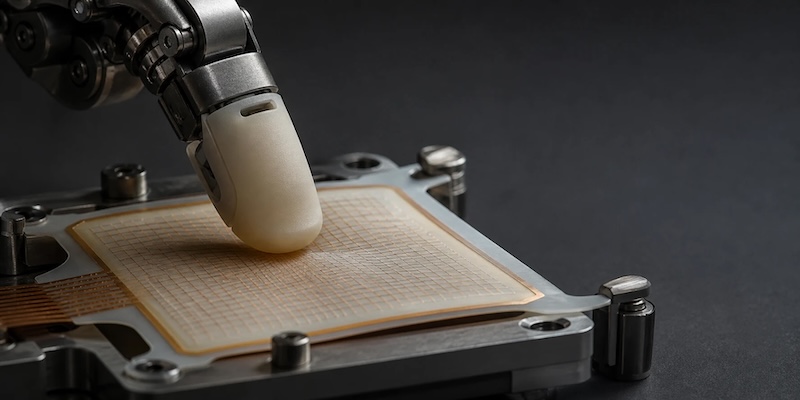
Scientists have developed a hybrid robotic skin that pairs electrical impedance tomography (EIT) with pneumatic pressure sensing to improve force detection across large surfaces of humanoid robots. The prototype, described in a May 2026 preprint, uses EIT to localize contact while four sealed pneumatic pads estimate applied force, addressing the sensitivity non-uniformity typical of large-area EIT-based tactile sensors.
Key takeaways
- In load-cell indentation tests, the coefficient of variation for sensitivity non-uniformity dropped from 0.31 (EIT alone) to 0.14 with the hybrid method.
- The chest-mounted version on a humanoid measures 280 × 280 mm, far larger than fingertip-scale sensors, and reconstructs EIT images at 100 Hz using a precomputed matrix.
- Pneumatic data rescales the EIT conductivity image, preserving contact location while improving force magnitude estimates; sequential dual-contact tests show the pad tracks combined force while EIT retains spatial separation.
- Limitations include reduced sensitivity near pad overlaps, no closed-loop safety testing, and unaddressed durability, cleaning, and temperature drift issues.
This sensor-fusion approach divides tasks between complementary technologies—EIT for spatial mapping, pneumatics for net force—offering a practical route to whole-body sensing for humanoids. Further work must integrate force maps into robot control for contact-aware movement and collision response.
Source: Robotics & Automation News · Published 2026-08-19T10:21:34 · “Scientists combine EIT and pneumatic sensing for humanoid robot skin”