
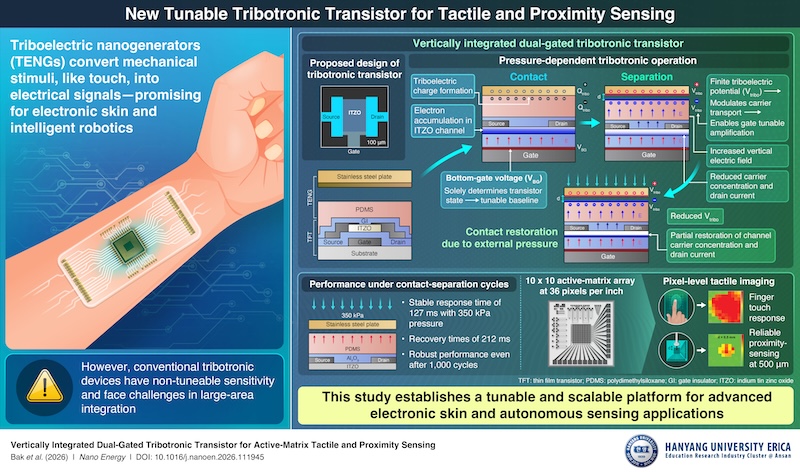
Researchers at Hanyang University ERICA have developed a vertically integrated dual-gate transistor architecture that could give robots and prosthetics reliable, human-like touch sensing. The design addresses limitations of conventional tribotronic devices, which offer fixed sensitivity and are difficult to integrate into large-area arrays.
Key takeaways
- Architecture: The device stacks a PDMS triboelectric sensing layer (top gate) over a gate insulator and an ITZO thin-film transistor (bottom gate), enabling gate-tunable amplification of triboelectric responses.
- Sensing mechanism: Triboelectric charges generated by contact with a stainless-steel plate create a top-gate voltage that modulates transistor current, allowing both contact and proximity detection (up to 500 µm).
- Performance: Response and recovery times of 127 ms and 212 ms, respectively, with stable operation over 1,000 cycles. Sensitivity increases with higher bottom-gate voltage and contact pressure.
- Demonstration: A 10×10 transistor array showed pixel-level responses to finger touches and proximity sensing, indicating scalability for high-density integration.
This technology provides a scalable platform for programmable, mechanically robust tribotronic sensor arrays, enabling electronic skin systems for healthcare robots, prosthetics, and wearable electronics, leading to safer human-machine interaction.
Source: Robotics & Automation News (roboticsandautomationnews.com) · Published 2026-08-10 · “Electronic skin gives robots and prosthetics ‘human-like touch sensing’”