
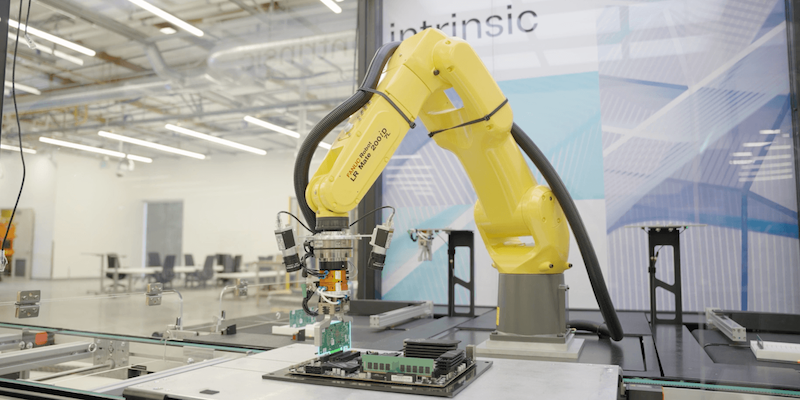
At Automate 2026, Intrinsic, Google's AI robotics company, outlined a vision for the software-defined factory, introducing the Intrinsic Intelligence Cell—a modular robot workcell built around software rather than hardware. Powered by IntrinsicOS, the cell serves as a reference architecture for manufacturers, machine builders, and integrators, enabling reconfiguration for different tasks without extensive engineering. The demonstration featured a Fanuc robot performing electronics assembly, showcasing AI-assisted perception, motion planning, and manipulation in a unified environment.
Key takeaways
- Intrinsic positions AI as the central operating layer, not an add-on, for future manufacturing systems.
- The Intelligence Cell supports multiple robot brands and tools, aiming to reduce engineering effort for high-mix production.
- Foxconn will pilot a customized version for electronics assembly later this year, testing real-world scalability.
- Interoperability with existing equipment (e.g., Fanuc) is a core focus, preserving manufacturers' prior investments.
- The AI for Industry Challenge with Open Robotics attracted 5,000+ participants (1,600 teams, 115 countries), with 93% Python-proficient and only 14% robotics professionals—signaling broader software developer interest.
Intrinsic is also working with CNC specialists Trinity Automation and MartinSystems to bring AI-powered machine tending to smaller manufacturers. The company emphasizes openness and interoperability over vertical integration, aiming to provide the intelligence layer that makes existing robots more adaptable. The shift from mechanical to software differentiation could redefine factory automation, though real-world deployments like the Foxconn pilot will be critical to validate the approach.
Source: Robotics & Automation News (roboticsandautomationnews.com) · Published 2026-07-09 · “Intrinsic’s vision for physical AI: Building the software-defined factory”