
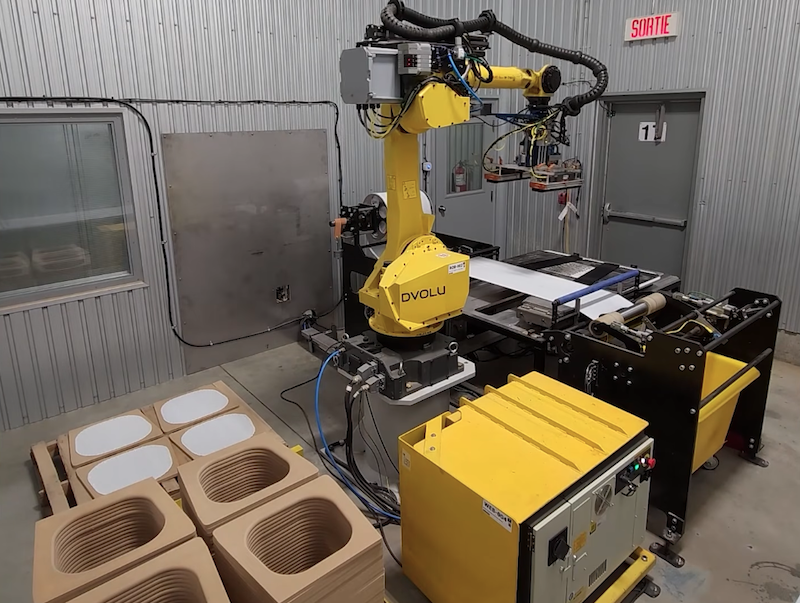
A Canadian furniture manufacturer has automated a traditionally labor-intensive upholstery process using a robotic work cell built around a Fanuc M-710iC industrial robot. Developed by Fanuc Authorized System Integrator Dvolu, the cell handles tasks that have historically required skilled human workers, including fabric stretching, stapling, trimming, and palletizing chair seat linings.
Key takeaways
- Machine vision identifies the exact position and orientation of seat cushions on pallets, enabling the robot to adapt to part variations without manual adjustment.
- The integrated cell combines vision-guided robotic handling with laser trimming, addressing the challenges of flexible materials that can stretch or wrinkle unpredictably.
- The system provides tangible labor relief for one of the industry's hardest positions to recruit and retain, tackling repetitive, high-volume manual assembly.
The project highlights robotics moving beyond traditional applications like welding and machine tending into tasks requiring dexterity and adaptability. The Fanuc M-710 Series robot offers medium payloads (12–70 kg), a slim wrist, high-axis speeds, and up to 3.1 meters reach. Dvolu noted that upholstery automation is genuinely hard due to fabric behavior and part variability, but the M-710iC delivered on all fronts. This deployment suggests that advances in robotics, machine vision, and automated handling are making even highly variable manufacturing processes suitable for automation.
Source: Robotics & Automation News (roboticsandautomationnews.com) · Published 2026-06-05 · “Fanuc-powered robotic cell automates one of furniture manufacturing’s toughest jobs”