
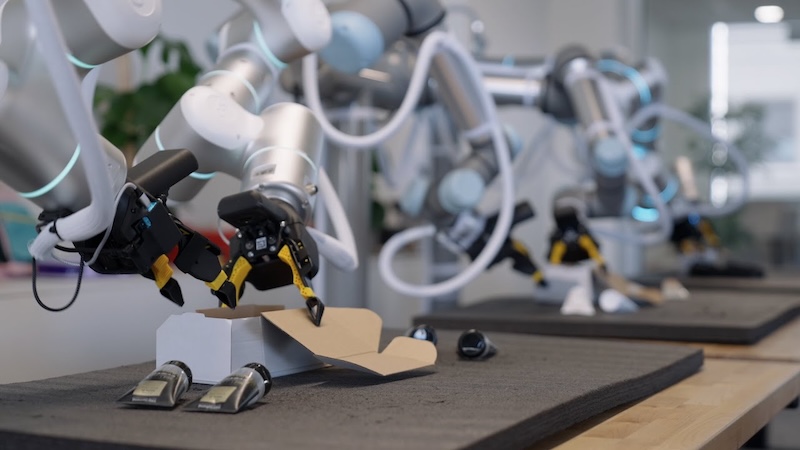
Generalist AI has unveiled GEN-1, an embodied foundation model designed for general-purpose physical tasks. The company reports that GEN-1 achieves up to 99% success rates on certain tasks, compared with about 64% for its predecessor, while completing tasks up to three times faster. It also requires only about one hour of robot-specific data to adapt to new tasks, highlighting its data efficiency.
Key takeaways
- GEN-1 combines perception, decision-making, and motion into a single system, enabling operation in dynamic, unstructured environments.
- Demonstrations show robots performing repetitive tasks like folding boxes, packing items, and assembling components over extended periods with minimal errors.
- The model leverages large-scale pretraining on human activity data from wearable devices, reducing reliance on expensive teleoperation datasets.
- Generalist AI acknowledges limitations, noting not all tasks reach production-level performance yet; early access is available to selected partners.
This release reflects a broader industry shift toward 'physical AI'—adaptive, learning-based systems that go beyond fixed automation. For manufacturers, GEN-1's potential to handle unstructured tasks with high reliability and speed could expand the scope of robotic automation, though further improvements are needed for broader deployment.
Source: Robotics & Automation News (roboticsandautomationnews.com) · Published 2026-04-11 · “Generalist AI unveils GEN-1 model, claiming breakthrough in real-world robotic task performance”