
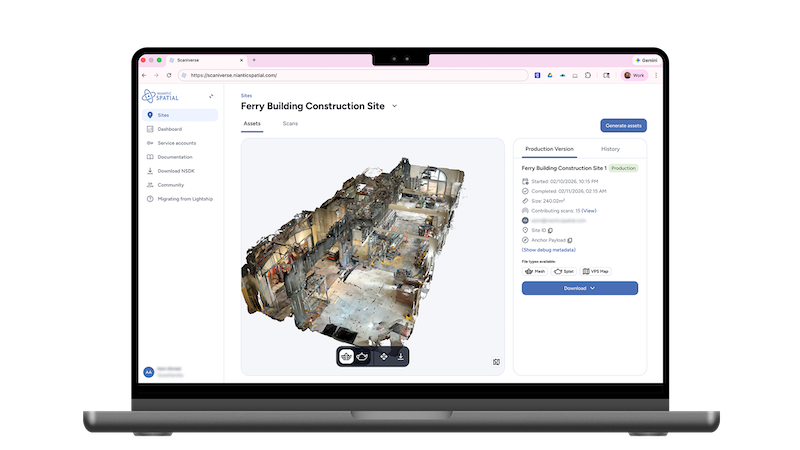
Niantic Spatial has introduced two new products to help AI systems operate in physical environments: Scaniverse for businesses and an updated Visual Positioning System (VPS 2.0). The company aims to address a key limitation in AI development—the lack of accurate, machine-readable maps of the real world. Many sectors, including construction, energy, logistics, and manufacturing, remain difficult for AI to access due to insufficient spatial data.
Key takeaways
- Scaniverse for businesses lets companies capture and reconstruct environments using smartphones or 360-degree cameras, generating 3D meshes and Gaussian splats for training and deploying robotics and AI systems.
- VPS 2.0 provides near centimeter-level positioning accuracy using camera input and computer vision, designed for areas where GPS is unreliable, such as indoors, underground, or dense urban settings.
- VPS 2.0 works without prior scanning for basic global positioning, then transitions to higher precision in mapped areas.
- The tools support collaborative data capture and cloud storage, handling environments from single rooms to large industrial sites.
- Niantic Spatial plans to release version 4.0 of its development kit later this month, adding support for Unity, Swift, Android, and ROS 2.
The company positions these launches within a broader effort to build a “Large Geospatial Model” for shared spatial understanding among machines. Delivery robotics firm Coco Robotics already uses VPS for navigation in its autonomous fleet. Niantic Spatial argues that progress in physical-world AI depends more on reliable spatial data than on advances in intelligence itself, making these tools relevant for robotics and industrial automation.
Source: Robotics & Automation News (roboticsandautomationnews.com) · Published 2026-04-08 · “Niantic Spatial launches two new world models to support real-world AI deployment”