
In context
In late 2025, the robotics industry was increasingly focused on humanoid robots for real-world industrial applications, with companies balancing dexterity, mobility, and operational efficiency. Richtech Robotics, a US-based provider of AI-driven robotics solutions, entered this space with its first humanoid robot, Dex, designed specifically for manufacturing and logistics tasks.
What was reported
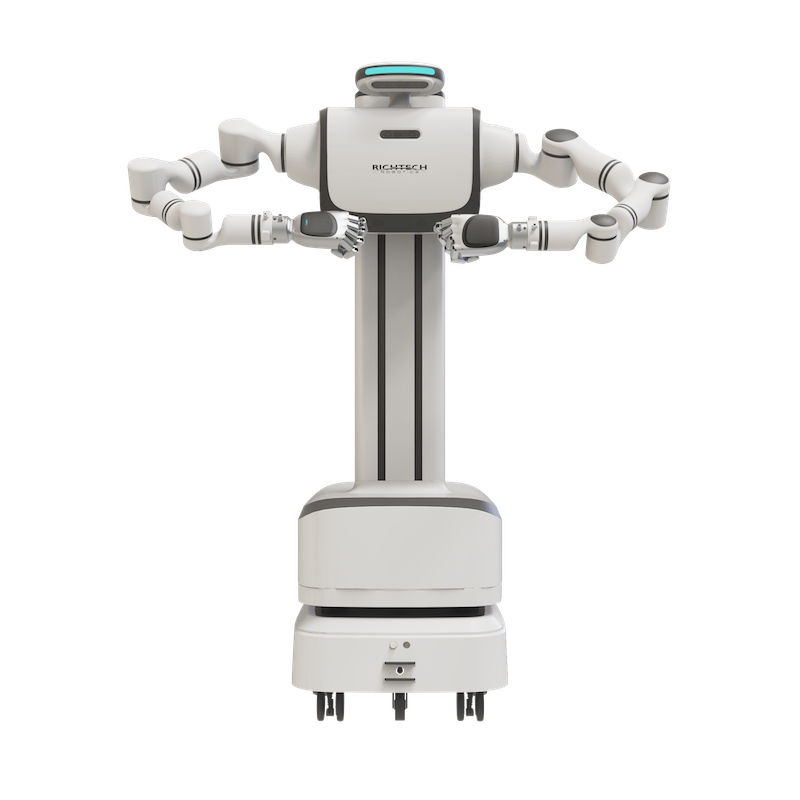
Dex is a mobile humanoid robot powered by the Nvidia Jetson Thor, enabling real-time reasoning and operation in dynamic environments. It features an eight-hour battery life in mobile mode and can run continuously from a static base. The robot combines the autonomous mobile robot (AMR) technology from Richtech's Titan delivery series with the dual-arm precision of its ADAM service robot line.
Richtech opted for wheels over legs, citing that bipedal gait offers no practical benefit in industrial settings and consumes excessive power, limiting runtime to as little as 15 minutes. The wheeled platform provides longer runtime, higher load capacity, better stability, and lower maintenance costs.
Training leverages Nvidia Isaac Sim for a 'Sim2Real' pipeline, combining simulated learning with real-world data to accelerate deployment. Dex can perform tasks such as machine operation, part sorting, material handling, quality inspection, and packaging. It is available for pilot programs and full-scale deployment.
“So we designed Dex to travel like a machine and perform tasks like a person.”
Why it mattered
Dex represents a practical approach to humanoid robotics, prioritizing uptime and efficiency over human-like locomotion. Its wheeled design and simulation-based training could make humanoid robots more viable for near-term industrial adoption, potentially easing labor strain as manufacturing returns to the US.
Source: Robotics & Automation News (roboticsandautomationnews.com) · Published 2025-10-28 · “Richtech Robotics unveils its first humanoid robot for ‘real-world work’”