
In context
In early 2024, the maritime industry was actively exploring autonomous surface ships (MASS) to improve safety and efficiency. However, most existing control systems, such as Model Predictive Control (MPC), were designed for calm waters and did not account for the complex forces—especially wave loads—that affect real ship manoeuvring. This gap limited the practical deployment of autonomous vessels in actual sea conditions.
What was reported
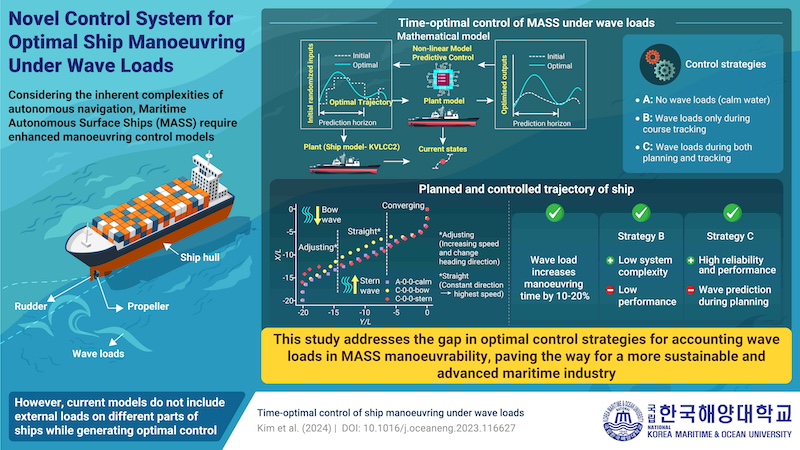
Researchers at Korea Maritime & Ocean University, led by Assistant Professor Daejeong Kim, developed a novel time-optimal control method for MASS that explicitly incorporates wave loads. The system uses a comprehensive mathematical ship model considering forces on the hull, propellers, and rudders, and a new time optimization model that transforms the formulation from temporal to spatial domain to optimize manoeuvring time.
These models were integrated into a nonlinear MPC controller and tested in simulations with a real ship model under varying wave loads. The team proposed three control strategies: Strategy A (no wave loads, reference), Strategy B (wave loads only in planning), and Strategy C (wave loads in both planning and tracking). Results showed that wave loads increased expected manoeuvring time in B and C, with C being more reliable but computationally heavier.
The study was published in Ocean Engineering (Volume 293, February 2024) and made available online in January 2024.
Why it mattered
This work addresses a critical shortcoming in autonomous ship control by making navigation systems more realistic and robust. By accounting for wave forces, the method enhances efficiency and safety of autonomous vessels, potentially reducing shipping costs and carbon emissions—key factors for the future of maritime automation.
“Our method enhances the efficiency and safety of autonomous vessel operations and potentially reduces shipping costs and carbon emissions, benefiting various sectors of the economy.”
Source: Robotics & Automation News (roboticsandautomationnews.com) · Published 2024-04-26 · “Korean scientists develop new navigation system for autonomous ships”