
In context
In early 2024, the construction industry was increasingly turning to automation to address labor shortages and the high cost of errors in site layout. Traditional land surveying, a critical pre-construction step, relied on skilled workers manually carrying GPS tools—a slow and expensive process. Civ Robotics, a startup founded in 2021, aimed to disrupt this by introducing precision layout robots that could be operated by anyone, promising to improve efficiency and reduce costs for large-scale projects like solar farms and road construction.
What was reported
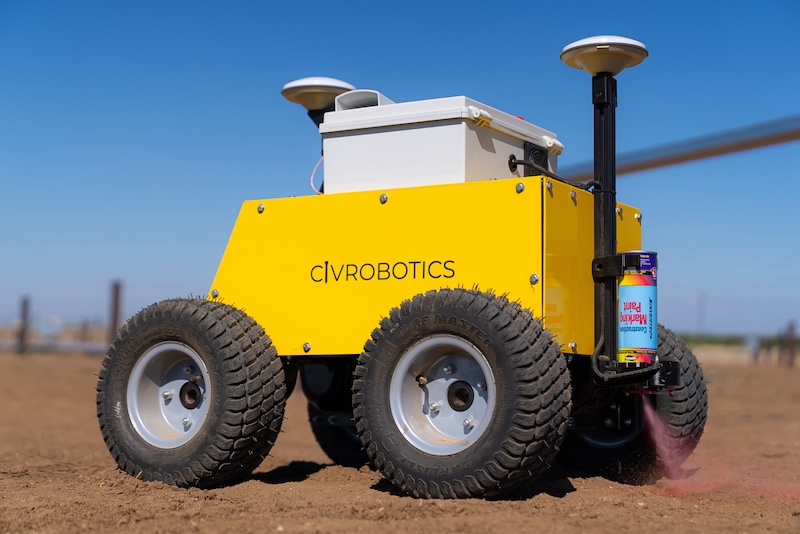
Civ Robotics demonstrated how its robot rovers, leveraging Point One's Polaris Real-Time Kinematics (RTK) network, can translate construction plans into real-world layout markings with accuracy within less than a centimeter. The system uses plug-and-go connectivity, eliminating the need for setting up and calibrating expensive base stations, which simplifies operation and reduces overhead.
The case study highlighted a significant productivity boost: while traditional surveyors could mark 200–450 coordinates per day, Civ operators using the robots could mark between 1,200 and 3,000 points in the same period—a roughly six-fold increase. This speed, combined with the simplicity of the product, was cited as a major cost-saving benefit for clients.
Since its market debut in 2021, Civ Robotics has expedited land surveying for dozens of clients across solar and road construction sectors. The company's COO, Liav Muler, praised the reliability of the Polaris RTK service, noting it as a go-to solution for NTRIP needs.
Why it mattered
This development underscored a broader trend in industrial automation: the convergence of robotics and high-precision positioning to automate traditionally manual, skill-intensive tasks. By making precision layout accessible to non-specialists and dramatically increasing throughput, such systems could reduce project delays and cost overruns in construction, paving the way for wider adoption of autonomous survey and layout solutions in heavy civil and infrastructure projects.
“It’s easy. It’s always working. There are no problems.”
Source: Robotics & Automation News (roboticsandautomationnews.com) · Published 2024-03-30 · “Civ Robotics shows how to improve pre-construction surveying efficiency by using robots and precision positioning”