
In context
In late 2023, stroke rehabilitation faced a persistent challenge: accurately measuring how patients use their affected arm outside clinical settings. Traditional assessments relied on observation, which could be subjective and often required patients to be unaware they were being tested—a paradox that limited real-world data. This new robotic system aimed to address that gap by providing objective, covert measurement of arm use.
What was reported
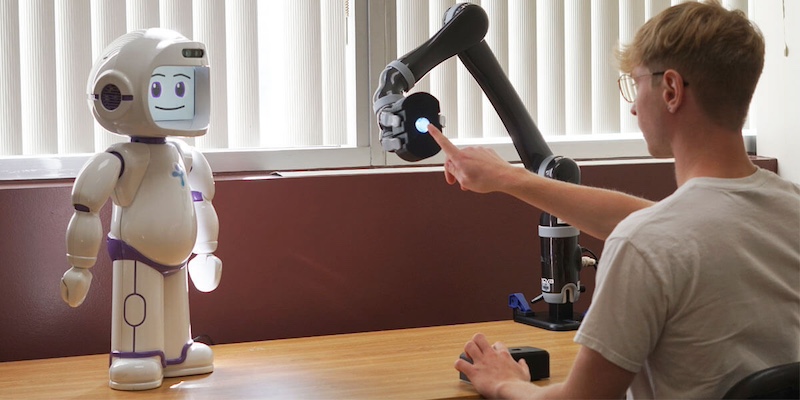
Researchers at the University of Southern California developed a novel robotic system to quantify arm non-use in stroke survivors. The system combines a robotic arm that tracks precise 3D spatial information with a socially assistive robot (SAR) that provides instructions and encouragement. Machine learning processes the data to generate an “arm non-use” metric, which reflects how spontaneously patients use their weaker arm.
In a study with 14 chronic stroke survivors, participants performed reaching tasks to 100 target locations. In one phase, they were free to use either hand; in another, they were instructed to use only the affected arm. The system measured arm use probability, time to reach, and successful reach, revealing differences in arm use patterns between participants. The method proved reliable across repeated sessions, and participants rated it as safe and easy to use.
Lead author Nathan Dennler noted that the time limit forced quick reactions, capturing natural hand choice. The researchers observed high variability in hand choice and reach times, with some participants showing reduced use of the affected arm in specific spatial areas. The team plans to explore personalization and incorporate additional behavioral data like facial expressions in future studies.
“This type of technology could provide rich, objective information about a stroke survivor’s arm use to their rehabilitation therapist,” said Amelia Cain, assistant professor of clinical physical therapy.
Why it mattered
This robotic assessment could transform stroke rehabilitation by giving therapists objective, detailed data on arm use in real-world-like conditions. By identifying specific weaknesses, therapists can tailor interventions more effectively, potentially improving recovery outcomes. The integration of socially assistive robots also hints at broader applications in automated patient assessment and motivation across rehabilitation and other healthcare settings.
Source: Robotics & Automation News (roboticsandautomationnews.com) · Published 2023-12-13 · “USC demonstrates new robotic system to assess mobility after stroke”