
In context
In late 2023, municipalities and industries were increasingly seeking non-destructive methods to inspect aging infrastructure and retrofit buildings for climate resilience. Robotic solutions that could navigate confined, hazardous spaces promised to improve worker safety and reduce costly, invasive inspections.
What was reported
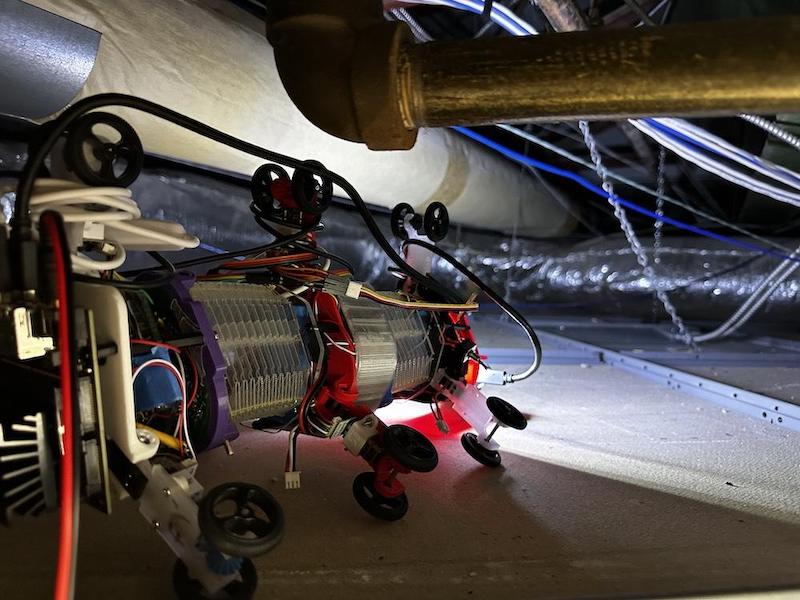
Researchers at Worcester Polytechnic Institute (WPI), in partnership with the City of Worcester, developed a lizard-like soft robot designed to creep into walls, ductwork, and pipes for inspection and 3D mapping tasks that are dangerous or impossible for humans. The project was funded by a $50,000 National Science Foundation grant.
The prototype uses an origami-inspired design with 3D-printed and laser-machined plastic parts, custom circuit boards, a miniature computer, sensors, and motors. It can deform its body to fit into small spaces, travel horizontally and vertically, and navigate maze-like structures without getting stuck. Its modular body allows multiple motors to climb over steps or operate within pipe networks.
Equipped with cameras and sensors for temperature and contaminant measurement, the robot operates with a degree of autonomy using AI, mapping areas it traverses. Tests were conducted in locations including Worcester City Hall and the Senior Center, where the robot maneuvered within walls, above drop ceilings, and into ductwork.
The team noted that the robot's video and 3D mapping capabilities could bridge the gap between blueprints and actual building conditions, which is especially valuable for older structures lacking detailed documentation. Matthew Urban, capital projects manager for Worcester, highlighted that current methods require cutting holes in walls to inspect, which can damage historic buildings.
Why it mattered
If commercialized, the robot could enhance worker safety and support sustainable building retrofits by enabling precise insulation assessments and climate adaptation measures. It also exemplifies 'public interest robotics,' where civic partnerships drive innovation for practical municipal challenges.
"Some of these places the robot can get into are not ideal for worker health."
Source: Robotics & Automation News (roboticsandautomationnews.com) · Published 2023-10-03 · “Worcester Polytechnic invents robot lizard to ‘sneak into small spaces’”