
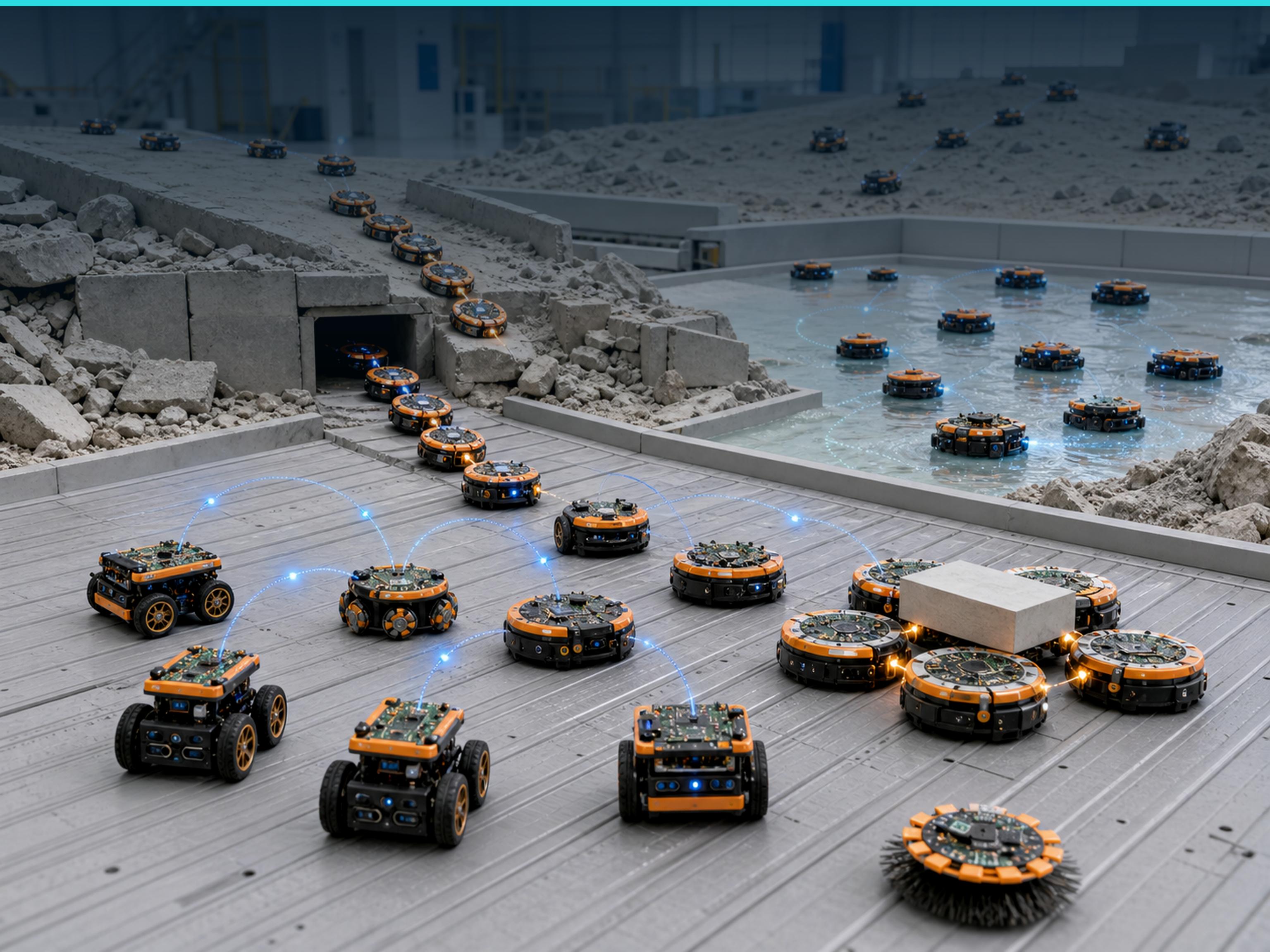
Swarm robotics is moving toward systems composed of many simple robots—low-cost, lightweight units with minimal sensing and control—that achieve complex collective behaviors through local interactions. A new review in the journal Robot examines this trend for extreme-environment applications such as disaster response and space or deep-sea exploration.
The review defines simple robots as those with single-modal or lightweight sensors (e.g., infrared, tactile), low-power microcontrollers, and rule-based control that maps inputs directly to actions without global modeling or complex planning. Their hardware simplicity keeps unit costs an order of magnitude lower than advanced robots, enabling mass production and large-scale deployment.
Research is structured along three dimensions: individual characteristics (mobility and architecture), group interaction (communication and environmental coupling), and system emergence (collective behaviors like aggregation, foraging, and transport). Mobility types include differential drive, omnidirectional, vibration-based, and collaborative modes that exploit environmental forces. Examples range from e-puck and Kilobots to bristle bots and magnetically coupled modular units.
Performance analysis methods are grouped into robot simulation, physical experiments, and formal verification. The authors note that while laboratory demonstrations are mature, transitioning to real extreme environments faces challenges in robustness, scalability, and validation.
Key takeaways
- Simple-robot swarms offer cost, energy, and robustness advantages over high-intelligence multi-robot systems in harsh conditions.
- Emergent group intelligence arises from local rules and interactions, not individual capability.
- Future work must bridge the gap between lab studies and field deployment in extreme environments.
Source: 《机器人》期刊 (robot.sia.cn) · Published 2026-07-15 · “从简智能体到群智涌现:面向极端环境协同作业的简智能体机器人集群系统”