

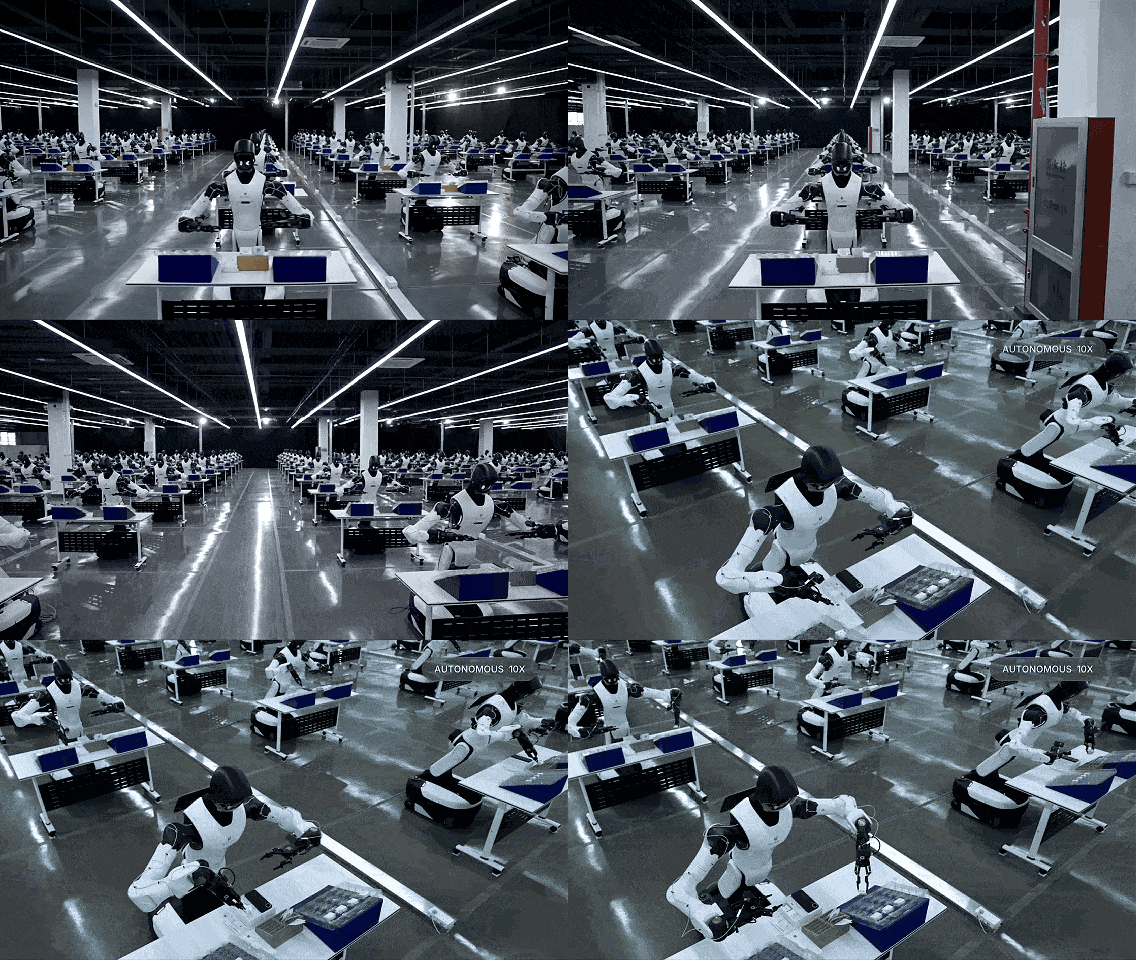
AGIBOT has unveiled GO-3 Preview, an embodied foundation model built on its proprietary WRAM (World Reasoning Action Model) architecture, which unifies task understanding, future-state prediction and action generation. The company reports first-place rankings on three embodied AI benchmarks — RoboDojo, RoboTwin and RoboColiseum — and says the model will be fully open-sourced by the end of 2026.
Key takeaways
- Architecture: WRAM combines three designs — CoAE (control-oriented visual encoding of object position, shape and spatial relations), SVP (single-step future-state prediction) and KASO (selecting predictions consistent with actions taken during training) — to align perception, prediction and motion.
- Full-lifecycle scaling: GO-3 Preview is paired with Genie Evolver, a hybrid post-training system spanning a fleet of 100 physical robots, physics simulation and world models, plus Genie Master, an embodied agent framework for coordinating task steps.
- Learning sources: Pre-training draws on heterogeneous data, including human first-person videos and robot trajectories, to build transferable skills rather than memorized motions.
- Adaptation: The model demonstrates zero-shot transfer to new tasks without task-specific supervised fine-tuning on physical robots, and few-shot refinement for precise work such as LEGO component grasping, alignment and insertion.
- Fleet learning: Collective Experience Learning (CEL) aggregates execution experience across robots, reusing successful trajectories and failure context so lessons benefit the wider fleet.
For manufacturing automation, the emphasis on post-deployment learning and shared fleet experience points toward systems that improve through production work rather than remaining fixed after commissioning. The planned open-source release may also lower the barrier for integrators evaluating embodied foundation models for assembly and precision manipulation.
Source: Robotics & Automation News · Published 2026-11-05T10:23:15 · “AGIBOT unveils GO-3 Preview and takes top spot on three embodied AI benchmarks”