
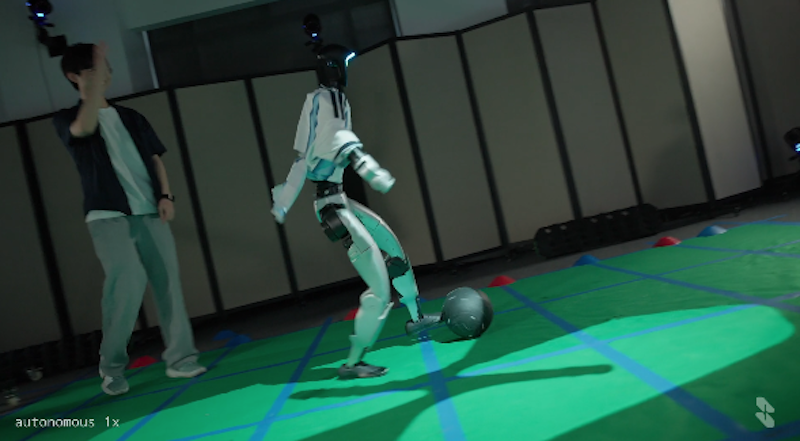
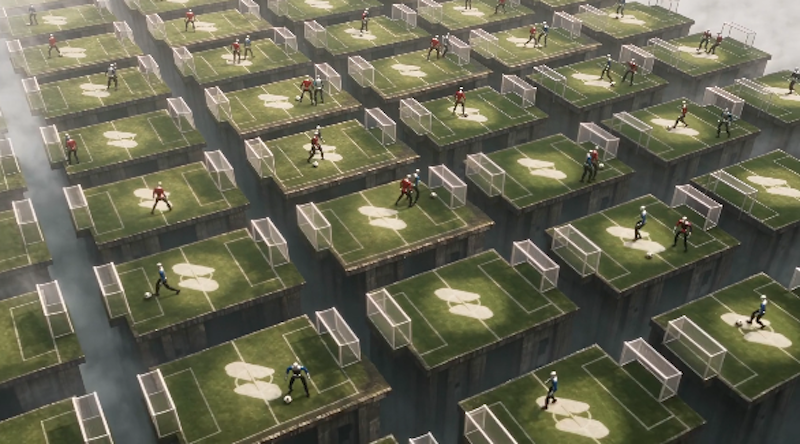
Skild AI has demonstrated a self-play training method that lets robots acquire physical skills without human demonstrations, using its S1 robotics foundation model to learn soccer through more than 140 years of simulated play. The company says the technique could eventually let robots pick up complex skills in factories, construction sites and homes without people demonstrating every action.
Key takeaways
- Setup: Skild built the environment in Nvidia Isaac Sim and gave the model a single objective — score a goal — rather than engineering separate rewards for dribbling, tackling or recovering from falls.
- Mechanism: The policy competed against progressively stronger recent versions of itself, so each capability gain produced a harder opponent.
- Emergent behavior: In the first simulated months the robot could barely walk; it later learned to recover after falling, dribble around defenders, shield the ball and tackle.
- Sim-to-real: After the simulated run, Skild transferred the policy to a physical humanoid and demonstrated it playing soccer, which the company calls a strong signal for self-play on the path to physical AGI.
- Multi-agent: Early four-agent experiments have begun producing passing and coordination, with collaborative manipulation and navigation flagged as future work.
The work is a post-training extension of S1, which Skild introduced in August and pre-trains on human videos, glove data, simulation and teleoperation. Skild argues that models trained mainly on human-generated data are capped at human capability, and that physical self-play could push robots beyond it. For manufacturing automation, the appeal is a way to scale robot learning: use human data to establish broad foundations, then let robots improve autonomously through large volumes of simulated experience — potentially easing the data bottleneck that constrains physical AI.
Source: Robotics & Automation News · Published 2026-10-16T08:00:14 · “Skild AI trains robots to learn physical skills through self-play”